After the Clocks Go Back: Seven Gentle Ways to Make Something Before 2026 Ends
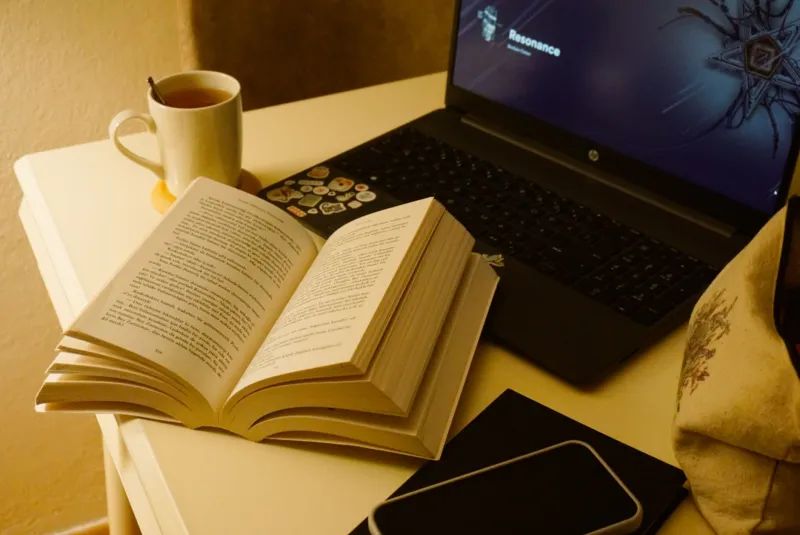
By 7 November, the UK has already settled into its long-dark groove. The clocks went back a week ago, the afternoon light has that pale, hurried quality, and by half four the kettle is doing more emotional work than the central heating. I like this stretch of the year, but I know it can flatten creative energy. The urge to make things does not disappear; it just gets quieter and needs a lower door to walk through.
This is not a productivity plan. It is a notebook page of seven small rituals I return to between November and the end of December, when the evenings are long and the year is running out. None of them require a studio, a streak, or a public declaration. They are things you can do at the kitchen table with a mug going cold beside you. Think of it as a page from my own notebook, the sort of thing I keep alongside the projects on gwenturner.co.uk.
1. Start with a ten-minute desk reset
Not a full tidy-up. Just ten minutes: clear the cups, put the pens back in one pot, brush the crumbs off the notebook, and open the window for two minutes even if it is freezing. The point is not a perfect desk. The point is a small physical signal that says: this is where something might happen.
I do this after dinner, when the dishes are done and the evening could otherwise slide into scrolling. A clear surface is easier to sit down at than a beautiful one. If you have a SAD lamp, this is also the moment to switch it on. If you do not, a normal lamp angled away from your face will do.
2. Keep one page for no audience
Take a single page, paper or digital, and write at the top: not for posting. Then put down whatever is in your head. A half-idea for a project, a line you overheard on the bus, a colour you keep noticing, a complaint about the darkness. The rule is that it does not have to become anything.
The internet trains us to think in finished posts, but most creative work begins as unshareable scribble. A page with no audience is a useful antidote to that. I keep mine in the same notebook for weeks. Sometimes nothing comes of it. Sometimes a sentence from that page turns into a piece of writing, a drawing, or just a better question.
3. Use the radiator sketch
This one is exactly what it sounds like. Sit near a radiator, take a pencil, and draw the nearest object for five minutes. A mug, a folded jumper, the corner of a lamp. The subject does not matter. The point is to let your hand move while your brain warms up.
Dark evenings are not good for detailed observational painting, but they are excellent for small, low-stakes sketches. I like this ritual because it has a natural end. Five minutes, one object, no pressure to produce a masterpiece. If you hate drawing, substitute a photograph, a collage from old magazines, or a paragraph describing the object in ridiculous detail.
4. Write a five-line evening log
At the end of the day, write five lines: what you noticed, what you made, what you avoided, what you are looking forward to, and one thing you want to remember. It takes two minutes. It is not a journal in the grand sense. It is a tiny record of a dark evening.
Over a few weeks, the log becomes a useful map of your own energy. You might find that Tuesday nights are for admin and Thursday nights are for making. You might notice that you consistently avoid a project you thought you loved. That is useful information, and it is much easier to see in five lines than in a crowded head.
5. Take one photograph of the ordinary
The UK in November is not short of atmosphere. Wet pavements, bus windows, string lights in a café, the blue hour at four o'clock. Take one photograph a day of something ordinary, and do not edit it. The point is to look, not to produce content.
I keep a small folder called dark days. It is not a portfolio. It is a reminder that the material for creative work is usually right there, even when the light is poor. If you want to make it slightly more sociable, send the photo to a friend with no caption. Let it be a small, wordless hello.
6. Do a tea-and-tidy edit
Make a cup of tea, sit down with something you have already made, and edit it for fifteen minutes. Not a new project. An old one. A paragraph, a photo selection, a half-finished page. The tea is not decoration; it gives the ritual a beginning and an end.
Editing is often easier than starting when you are tired, because the raw material is already there. I use this for website copy, short pieces of writing, and the occasional pile of unorganised notes. The aim is not perfection. The aim is to leave the thing slightly more itself than you found it.
7. Close the week with a Friday note
On Friday evening, write a short note to yourself about the week. What worked? What did not? What is one small thing you want to carry into next week? Keep it to half a page. Then close the notebook.
This ritual is especially useful in December, when the year-end noise starts up and every platform wants a summary of your achievements. A private Friday note is a quieter alternative. It lets you mark time without turning your life into a performance review.
The point is not to keep up
The temptation in November and December is to treat the remaining weeks as a countdown. Finish the year, clear the decks, make a plan. But the dark evenings are not a problem to be solved. They are a different kind of working condition.
These seven rituals are deliberately small. They are designed for days when you are tired, cold, and not particularly inspired. The aim is not to produce more. It is to stay in contact with the part of you that notices things, makes things, and wants to put something into the world before the year turns.
If you try one, start with the ten-minute desk reset. It is the least romantic and the most reliable. Then make a cup of tea, open a notebook, and see what happens. The evenings are long. There is room for something small.