The Front Room, Unfinished: Notes From a Tiny Open Studio
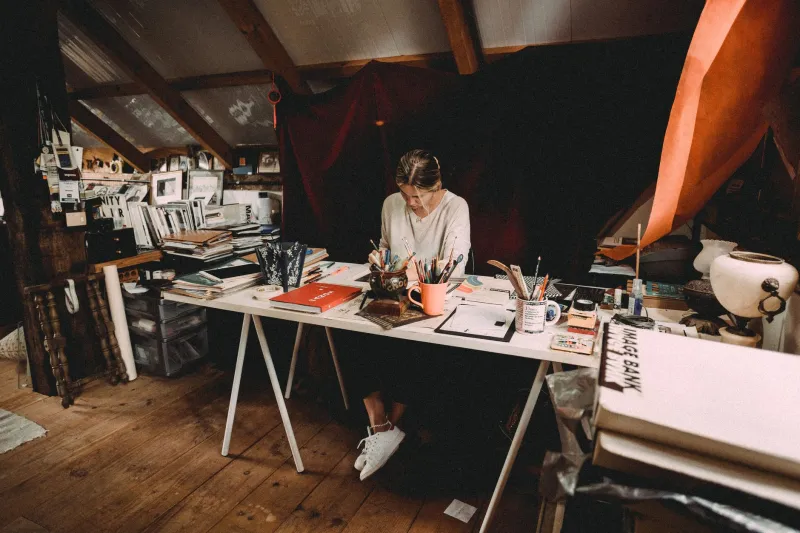
I live in a Victorian terrace with a front room that is roughly sixty per cent desk, thirty per cent cat hair, and ten per cent good intentions. Calling it an open studio was generous. Calling it 'come and look at my messy table' would have been more accurate. But I had been sitting on a pile of half-finished work for months, and the idea of showing only the polished things felt like a lie with a nice frame around it.
So I set a date. I printed a small notice for the deli noticeboard, put a post in the neighbourhood WhatsApp group, and invited a handful of people I knew loosely. Twelve said maybe. Four came. One brought her sister. I spent forty minutes arranging a table of unfinished work and then put a tea towel over it because I panicked.
The guest list
This was not a private view. There was no wine, no playlist, no carefully angled lamp. There was a kettle, a tin of biscuits, and a cat who kept sitting on the only chair with good light. I told people the work was unfinished. I put a small handwritten label on the table: 'Nothing here is finished. Some of it may never be.'
That label did more work than I did. It gave everyone permission to look without judging, and it gave me permission to stop apologising for every pencil mark.
What I actually showed
A half-painted canvas that had been leaning against the wall since the summer. Three sketches from a notebook I usually hide. A lino print that went wrong in an interesting way. A pile of fabric scraps from a project I am still not ready to talk about. And a small stack of rough drafts for something that might become a zine, or might become a drawer of paper.
I did not show the finished pieces. That was the point. A finished piece says 'this is what I do'. A rough draft says 'this is what I am trying to do'. The second one is much more uncomfortable to put on a table.
The conversations
A woman spent ten minutes looking at a rough sketch and said it reminded her of her mother's kitchen. It was not a drawing of a kitchen. It was a drawing of a chair. But she was right about the feeling, and we talked about her mother for twenty minutes while the kettle boiled again.
A retired art teacher told me my perspective was 'brave', which I have chosen to take as a compliment. A man asked if the lino print was supposed to be a bird. It was not. I said it was a shape. He nodded as if I had said something profound. I have since decided it is a bird.
One person asked if I sold anything. I said not really, and they looked relieved. That was a useful lesson: not every creative gathering has to become a shop. Some people just want to see how the sausage is made, or in my case, how the slightly wonky lino print is made.
The awkward bits
The first person arrived early while I was still hiding laundry in the bedroom. I offered tea before I had found the teapot. Someone asked to use the loo and I had to move a drying rack out of the way. The cat was sick behind the sofa at 3.10pm. I cleaned it up and said nothing, which felt like a small act of hosting heroism.
I also spent the first twenty minutes explaining things nobody had asked about. I gave a long speech about why the canvas was unfinished, and then a friend said, 'It's fine, Gwen, we can just look at it.' She was right. I stopped talking. The room got better.
Practical notes if you fancy doing it yourself
- Pick a short window. Two hours is plenty. Three is a marathon. Four is a hostage situation with biscuits.
- Invite fewer people than you think. Four was perfect. Eight would have been a party. Twelve would have been a fire drill.
- Clear one surface, not the whole house. Nobody needs to see your bedroom. They came for the work, not for a property inspection.
- Label unfinished work clearly. It lowers the stakes for everyone.
- Have tea and something plain. Biscuits are good. Grapes are optimistic and will go untouched.
- Ask a friend to handle the door. It gives you one job fewer and makes the room feel less like a trap.
- Prepare one sentence per piece, not a speech. 'This is a chair, I got stuck on the shadow' is enough.
- Let silence happen. Someone looking quietly is not someone who is bored. They are probably thinking.
- Do not turn it into a shop unless you want to. 'Not for sale' is a complete sentence.
- Write down the questions people ask. They will tell you what the work is actually doing, which is rarely what you thought.
What I would do differently
I would put the tea things out before the first guest arrives. I would not hide the laundry in a way that made the wardrobe door bulge. I would make a small sign for the loo so nobody has to ask. And I would trust the rough work a little sooner.
The front room is still a front room. The work is still unfinished. The cat has forgiven me. But the door has been opened once, and that feels like progress. If you have been sitting on a pile of half-finished things, wondering whether they are ready to be seen, they probably are not. That might be exactly why you should show them.