The Shelf of Almosts: Why Failed Makes Deserve to Stay
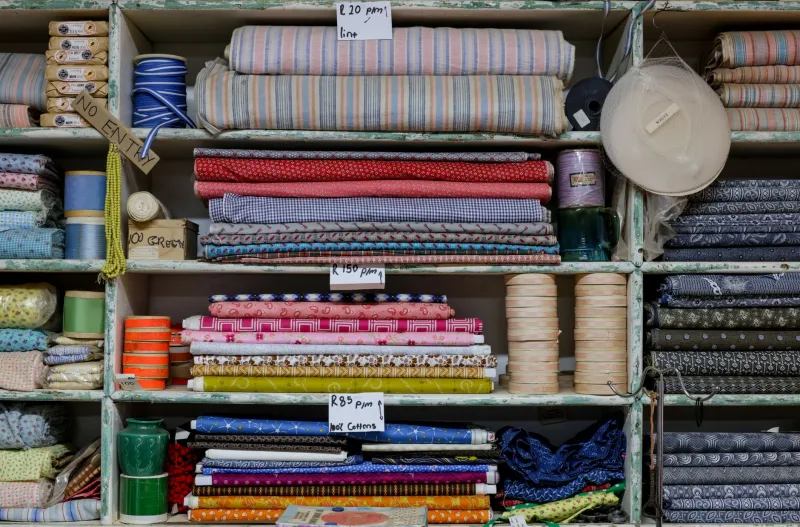
On the top shelf of my spare room, behind a box of Christmas decorations and a fan I refuse to admit is broken, there is a shelf of almosts. A lino print with a wobbly border and a thumbprint in the ink. Half a crochet blanket in a colour I would never choose now. A typed essay that starts well and ends in a paragraph I can’t defend. A small stitched sample that was supposed to become a cushion and became a lesson instead.
For years I thought of that shelf as evidence of failure. Every time I reached past it for something else, I felt a small, familiar wince. Then, earlier this year, I started asking other makers what they wished they had kept, and I realised that my shelf wasn’t a bin I hadn’t got round to emptying. It was an archive. Not a grand archive, not the sort with acid-free boxes and a catalogue. Just a record of the things I tried before I knew what I was doing.
The shelf in question
This is not an argument for keeping everything. I am not suggesting we turn our homes into museums of every bad drawing and half-finished scarf. Clutter is real, and so is the guilt that comes with it. But there is a difference between keeping with intention and keeping out of shame. The failed-project shelf is only useful if you can look at it without flinching. That’s the part I’ve been working on.
Failure is data, not a verdict
A failed project is information. It tells you what you don’t want to make, which is often more useful than knowing what you do. It tells you where your patience runs out, which materials fight back, which ideas need a different shape. It tells you that you showed up, which is not nothing in a year when everyone is tired and the news is loud.
The trouble is that we tend to treat creative work as a verdict on us rather than a record of an experiment. If a piece doesn’t work, we don’t say “that test didn’t work.” We say “I’m not good at this.” That’s a heavy thing to hang on a wonky bit of lino. The shelf of almosts is a place to put the experiment back where it belongs: on a shelf, not on your sense of self.
A gentle audit, not a clear-out
If you have a shelf like mine, you don’t need a dramatic decluttering session. You need a gentle audit. Set aside twenty minutes — not a whole afternoon, not a weekend — and take one thing down at a time. Ask three questions. What was I trying to do? What did I learn? Do I want to keep this as a record, reuse it, or retire it? The third question is the important one. You are allowed to retire things.
I use three boxes now: keep, reuse, release. Keep is for the pieces that still have a pulse, even if the pulse is faint. Reuse is for materials or parts that can become something else. Release is for the things that have done their job and don’t need to take up space. The release box is not a bin of shame. It’s a way of saying thank you and moving on.
Reuse without forcing a comeback
Some failed projects don’t want to be finished. They want to be cut up. A bad print can become collage fodder or packing paper for parcels. A sample that didn’t work can be overdyed, overprinted, or used as a backing. A half-finished piece of knitting can be unravelled if the wool still has life in it, or felted if it doesn’t. A typed essay can be mined for a paragraph that belongs somewhere else.
The trick is not to turn reuse into another performance. You don’t have to post the before-and-after. You don’t have to call it a “glow-up.” You can just put the failed thing back into the stream of materials and let it become something less precious. In a small flat, that might mean one box under the bed rather than a shelf. In a house with a loft, it might mean a labelled bag that you can actually find again.
Retire with a small ceremony
For the things you truly don’t want to keep, a small ceremony helps. Not a ritual with candles and a speech, unless that’s your thing. Just a moment of acknowledgement. Photograph the piece if you want a record without the object. Write one line in a notebook: “Learned that I hate sewing with slippery fabric.” Then recycle it, charity-shop it if it’s genuinely useful, or put it on Freecycle. The point is to stop the object from carrying a verdict it never deserved.
I did this with a batch of bad prints last winter. I kept one — the one with the thumbprint — and released the rest. It was not cathartic in a dramatic way. It was just quiet. The shelf had more room. I had more room. Nothing about me had changed except that I had stopped pretending the shelf was invisible.
What the shelf actually teaches
The failed-project shelf is not a monument to wasted time. It is a record of trying, and trying is the whole job. If you make things, you will make things that don’t work. That is not a flaw in the process; it is the process. The shelf is there to remind you that the polished thing you show people is only the top layer. Underneath it are the tests, the mistakes, and the almosts.
So I’m keeping my shelf. I’m keeping the thumbprint print, the crochet blanket that may never be a blanket, and the essay that ends badly. Not because they are good, but because they are mine, and because they are proof that I kept going. If you have a shelf of almosts, you don’t have to love it. You just have to stop hiding from it.