Four Switch-Ons, One Folding Stool: Drawing the Crowd Before the Bulbs Go On
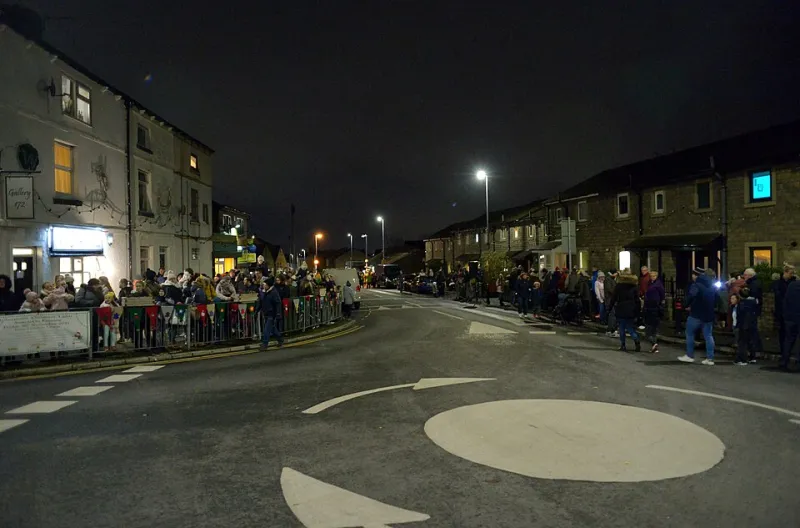
Photo: habiloid , CC BY-SA 2.0, via Wikimedia Commons
There is a particular sound a town square makes about twenty minutes before the Christmas lights come on. It is not quite a roar. It is more of a rustle with a brass band somewhere underneath it, a school choir testing the microphone, and at least one child asking whether it is nearly time. I heard that sound four times this November and December, from four different folding stools, at four different switch-on nights in 2026.
The plan was simple enough: turn up early, find a spot at the edge of the crowd, and draw. Not the stage, particularly. Not the celebrity guest or the local mayor in the chain. The crowd itself — the hats, the prams, the late arrivals, the people holding paper cups of something hot, the ones who stand with their backs to you because the best view is always slightly to the left of where you have set up.
Before the countdown: the square as a stage
A switch-on is civic theatre, and like any theatre it has a front of house. By half past four, the square is already rearranged. Barriers appear. A steward in a high-vis jacket moves a cone with great seriousness. Someone tests the tree lights and a small cheer goes up, premature and hopeful. Shopkeepers stand in doorways with their arms folded, watching the evening arrive.
I drew that bit first, because it is the part nobody photographs. The square before the crowd is a set waiting for its actors. I sketched the empty bandstand, the taped-off cable, the man carrying a second cone to a place where the first cone clearly should have been. A woman asked if I was from the council. I said no, I was drawing. She looked at the page, said “right you are”, and went back to guarding a gap in the barriers.
That is one of the small pleasures of drawing in public: you become furniture with a purpose. People stop explaining themselves to you. They just get on with the business of waiting.
Permission, puddles and the politics of a good spot
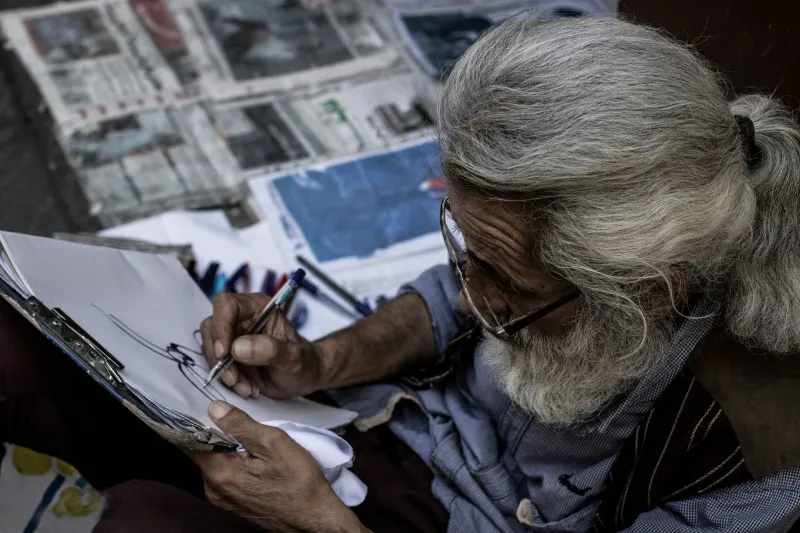
My rules for the four evenings were not complicated. Ask a steward if there is somewhere I should not be. Keep the kit small. Never stand in the middle of a walkway. And if someone asks what I am doing, answer in one sentence and show them the page if they seem interested.
The first evening was damp. Not raining, exactly, but the sort of fine November moisture that makes pencil go soft and paper go wavy. I found a dry-ish spot under a shop awning, tucked the stool against a planter, and drew the queue for the mulled wine van. The queue was better than the van. There was a man in a Santa hat explaining the correct order of operations for a Christmas shopping trip to his friend, who was not listening. There was a dog in a coat. There was a teenager holding a phone up to film the tree and then immediately watching the tree through the phone.
The second evening was colder and busier, in a Yorkshire market square where the brass band had brought its own lights. I learned that the edge of the crowd is a moving thing. You think you have found a quiet corner and then a pram arrives, then a scooter, then a family who have clearly decided that this exact patch of paving is the only place their children will be able to see. I moved twice. That is fine. Moving is part of the job.
The moment the bulbs go on
Here is what I had forgotten about switch-on nights: the big moment is short. There is a countdown, a cheer, a brief wash of light, and then everyone immediately looks at their phones to check the time or take a photograph that will not capture it. The real drawing happens in the ten minutes after, when the crowd relaxes and the square becomes a place to stand rather than a place to look.
On the third evening, in a seaside high street with a cold wind coming off the front, I drew the backs of four people watching a choir. I could not see their faces and it did not matter. The set of their shoulders told me everything: the tall one leaning slightly towards the short one, the child lifted onto a parent’s shoulders, the older couple standing close but not touching, each holding a paper cup. When the lights came on, nobody moved. They just tilted their heads up and kept holding the cups.
That was the sketch I liked best. Not the tree. Not the stage. The ordinary architecture of people standing together in the cold because something small and bright was about to happen.
What four evenings taught me about standing still
Drawing at a public event is mostly a lesson in not being the main character. You are not there to perform. You are there to notice. That means keeping your elbows in, your bag under the stool, and your expectations low. Some evenings you will make one good drawing and three bad ones. Some evenings you will make nothing but a page of notes about the weather and a small child’s very specific hat.
It also teaches you that “getting a good spot” is not the same as “getting a good drawing”. The best views are often slightly awkward to stand in. The most interesting people are rarely at the front. And the moment everyone else is photographing is usually the least interesting moment to draw, because it is the moment when everyone is doing the same thing.
How to draw a switch-on without ruining anyone’s view
If you fancy trying this next year, here is what I would pass on.
Arrive early enough to see the square before the crowd. That is when you get the good civic details: the cones, the cables, the steward’s clipboard, the shopkeeper’s folded arms.
Ask first. A quick word with a steward or organiser will usually get you a friendly nod and a suggestion of where not to stand. Do not set up in a walkway, in front of a barrier gap, or anywhere a pram would need to pass.
Keep the kit small. I used an A5 sketchbook, two pencils, a water brush and a small board. A folding stool is optional but useful; a tripod or easel is not. At a crowded switch-on, less kit means more goodwill.
Draw the crowd, not just the lights. The bulbs are the excuse. The people are the event. Backs of heads, gloved hands, the way a scarf sits on a shoulder — these are the details that make a drawing feel like it was made in a real place on a real evening.
Be ready to be asked what you are doing. Answer briefly, show the page if you like, and then go back to drawing. Most people are kind. Some are curious. A few will tell you their cousin draws. All of it is part of the evening.
And finally: dress for the cold. You cannot draw for long if your hands stop working. I learned that on the fourth evening, in a London borough piazza where the wind came round the corner of a council building like it had a grudge. I lasted forty minutes, made two decent sketches and one very wobbly drawing of a mince pie, and went home via the bus with my fingers wrapped round a cup of tea.
That, in the end, is the switch-on I remember most clearly. Not the countdown. The walk back to the bus stop, past the lit tree and the emptying square, with a sketchbook full of other people’s evenings.