The Frame Comes Second: Learning to Finish Drawings With Other People’s Cast-Offs
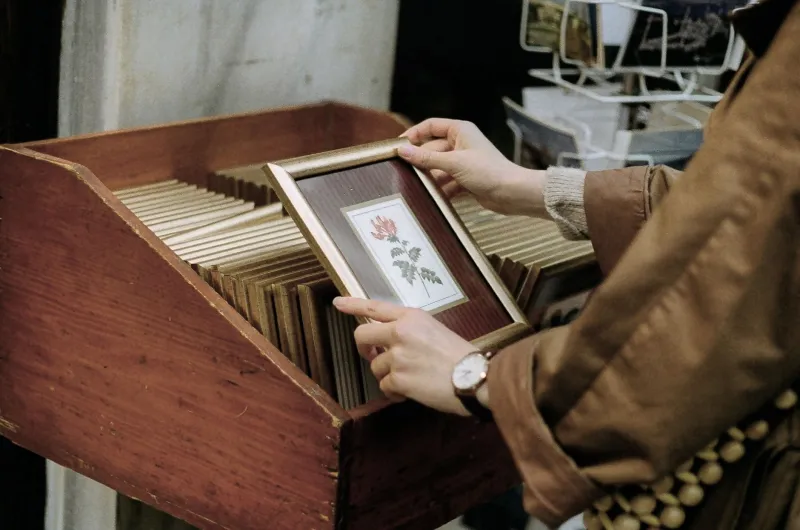
For years my finished drawings lived in a drawer because framing felt like a luxury I kept postponing. In May 2026 I started buying frames from charity shops, car boot sales and the occasional skip, and by November 2026 the work — and the way buyers saw it — had changed. This is what six months of secondhand framing actually cost, taught and complicated.
Why I stopped leaving finished work in a drawer
The drawer was never a moral failing. It was a maths problem. A decent new frame for an A4 drawing can easily cost £25 to £40 once you add a mount, and when you are selling small pieces for £30 or £40, the frame starts to eat the work. So the drawings stayed flat, safe and unseen. I told myself I was protecting them. Really, I was postponing the moment when they had to look like objects in the world.
What changed was a £3 wooden frame from a charity shop in May 2026. It was ugly in the way that only a 1980s front-room frame can be — heavy, dark, slightly scratched — but the joints were tight and the glass was clean. I put a small ink drawing in it, and suddenly the drawing looked deliberate. Not expensive. Deliberate. That was the beginning.
The real maths of a secondhand frame
Over six months I bought 31 frames. I kept a note of every one, because I am that sort of person. The cheapest was £1 from a car boot sale; the most expensive was £12 for a large, solid-oak frame in a charity shop in Lewes. Most were between £2 and £6. I spent about £38 on mounts, £14 on backing board, £9 on hanging hardware and £11 on cleaning materials. A few frames needed small repairs: wood glue, a clamp, replacement staples.
When it worked, a finished piece could come in under £15 in materials. That is still money, but it is not the same as £40. More importantly, it let me price finished work at a level that felt honest for the piece and the frame together, rather than pretending the frame was free.
The hidden cost is time. You cannot walk into a charity shop and expect the right size. You have to go often, measure everything, and accept that most frames are the wrong shape, the wrong depth, or held together by hope and old Sellotape. I started carrying a small tape measure and a note of the standard sizes I use. It made me look slightly unhinged in the British Heart Foundation, but it saved a lot of guessing.
Sizing, mounts and the small indignities of A4
A4 is 210 by 297 millimetres. A3 is 297 by 420. Charity shops, however, are full of frames built for 10 by 8 inches, 12 by 10 inches, 16 by 12 inches, and whatever size someone’s auntie had above the loo in 1994. The maths is not hard, but it is fiddly. You need the rebate measurement — the inside lip where the glass and artwork sit — not the outside edge. I learned that the hard way after buying a beautiful frame that was two centimetres too small in every direction.
Mounts solve most of this. A mount can take an A4 drawing up to a 12 by 10 frame, or an A5 sketch up to an A4 frame, and the extra border often makes the work look better anyway. I started buying ready-cut mounts online in batches, which kept the cost down. For odd sizes, I cut my own from mount board with a craft knife and a steel ruler. My first attempts were crooked. My later attempts were only slightly crooked, which is progress.
The other indignity is depth. Old frames are often shallow. If you want a mount and a backing board, you need enough room in the rebate. I now check with a small piece of card before buying. If the frame is too shallow, it becomes a frame for something flat and unfussy — a print, a photograph, a small drawing without a mount. Not every rescued frame has to carry a masterpiece.
The ethics of an empty frame
There is something odd about buying a frame that still contains someone else’s family photograph. I found wedding pictures, school portraits, a certificate for a caravan site in Rhyl, and one very stern spaniel. I never throw the photographs away. I take them out carefully, keep them in an envelope, and either leave them with the shop or pass them to the till volunteer with a note. It feels wrong to bin a stranger’s face, even if the frame is now mine.
The ethics go beyond the photograph. A secondhand frame has a history. It may be scratched, repaired, or slightly warped. I do not try to hide that. I clean it, tighten the joints, replace the backing if it smells of damp, and then I let it be old. Buyers are not stupid. They can see that the frame has had a life. What they seem to mind is not the wear but the uncertainty — the feeling that the work has been shoved into any old thing without care.
What buyers said when the work arrived finished
The shift was immediate and slightly embarrassing. People who had seen my unframed drawings on the website had been polite. People who received framed work were enthusiastic. One buyer in Bristol said it was the first time she had bought art that she could hang straight away. Another asked where the frame came from, not as a complaint but as a story. A third admitted she had expected something flimsier and was pleased the frame had weight.
Not everyone loved it. One person asked if I could swap the frame for a plainer one. I could, and I did, because that is the job. Another said the glass had a faint scratch. It did. I had missed it in the shop light. I knocked a fiver off and learned to check glass against a dark background.
The biggest change was in how I talked about the work. A framed drawing is easier to describe as a finished object. It has edges. It has a weight. It can be wrapped in bubble wrap and handed over. That sounds small, but it changed the way I felt about selling. The work was no longer a file or a sheet in a drawer. It was a thing that could leave the house.
How to spot a decent frame in a shop full of tat
First, ignore the picture. It is almost always the least useful part. Turn the frame over and look at the back. Are the joints tight? Is the backing board solid or crumbling? Are the hanging fixtures screwed in rather than glued on with optimism? A frame with a bad back is usually a bad frame.
Second, measure the rebate, not the outside. Take a tape measure. Check the depth. Check that the glass is not scratched, chipped or loose. Hold it up to the light at an angle. If the glass is dirty, that is fine. If it is scratched, walk away unless you plan to replace it.
Third, check for warp. Lay the frame on a flat surface. If it rocks, it will never hang flat. Small warps can be fixed with a backing board and firm hanging wire, but big warps are a headache. Fourth, smell it. Damp and mould are hard to get rid of and not worth the fiver you saved.
Finally, be realistic about style. An ornate gold frame can be magnificent, but only if the work can carry it. A plain wooden frame is easier to live with. I now buy fewer, better frames and leave the tat for someone else. That is the real lesson of six months: a secondhand frame is not a bargain if it makes the work look like an afterthought.
What I’m doing differently from now on
By November 2026 I have a shelf of frames waiting, a drawer of mounts, and a much better idea of what I will and will not buy. I still keep an eye out for skips, but only for solid wood and clean glass. I still make mistakes. The difference is that the finished work is no longer waiting for permission to exist. The frame comes second, but it turns out it matters more than I thought.